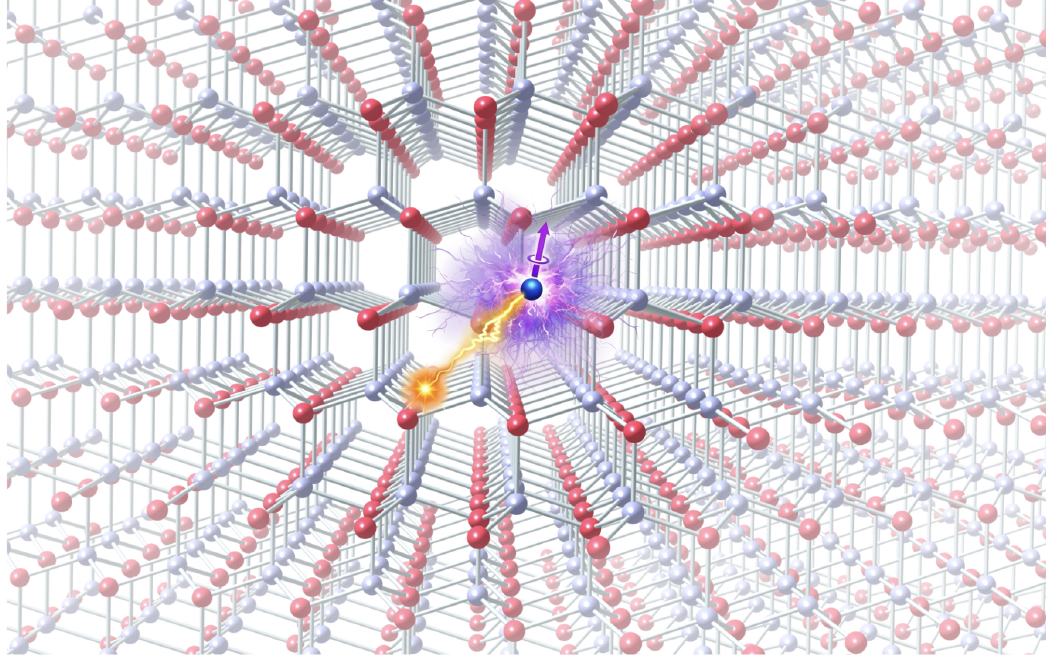
Congratulations to Shimin Zhang, Erik Perez, Taejoon Park, Kejun Li, Hosung Seo, and Yuan Ping for their work with Xingyi Wang, Masoud Mansouri, Yanyong Wang, Jorge D. Vega Bazantes, Ruiqi Zhang, Jianwei Sun, Kai-Mei C. Fu on “Deep spin defects in zinc oxide for high-fidelity single-shot readout”, published in PRX Quantum on March 23 2026! Link to the published article.
Wide-band gap oxides such as ZnO are favorable hosts for spin defect qubits due to their dilute nuclear spin background and potential for ultra-high purity. Yet, a deep-level defect qubit with robust optical and spin properties has not been identified in this material. Here, using first-principles calculations, we predict that the molybdenum–vacancy complex, (MoZnVO)2+, exhibits the essential characteristics of an optically addressable spin qubit: a spin-triplet ground state, visible-range optical transitions with high quantum yield, and an unusually small Huang–Rhys factor (∼5, compared to 10–30 in known ZnO defects). We further find long spin coherence times (T2 ∼4 ms) when both nuclear and impurity spin baths are considered, with paramagnetic impurities setting a threshold concentration of 0.035 ppm. Importantly, the combination of strong spin–orbit coupling and the absence of Jahn–Teller distortion supports spin-selective intersystem crossing and high-fidelity single-shot readout at elevated temperatures and across wide magnetic field ranges. By establishing ZnO as a new host for deep-level defect qubits, our work opens a pathway to scalable, integrable oxide-based quantum technologies and expands the material foundation for solid-state quantum information science.
We acknowledge the support by AFOSR CFIRE program under grant FA9550-23-1-0418. This research used resources of the Scientific Data and Computing center, a component of the Computational Science Initiative, at Brookhaven National Laboratory under Contract No. DE-SC0012704, the National Energy Research Scientific Computing Center (NERSC) a U.S. Department of Energy Office of Science User Facility operated under Contract No. DE-AC02-05CH11231. This work used the TACC Stampede3 system at the University of Texas at Austin through allocation PHY240212 from the Advanced Cyberinfrastructure Coordination Ecosystem: Services and Support (ACCESS) program